
Safety in the warehouse
The topic of safety in warehouse traffic with forklift trucks is regularly on the to-do list of business owners and plant managers. The protection of employees is the top priority.
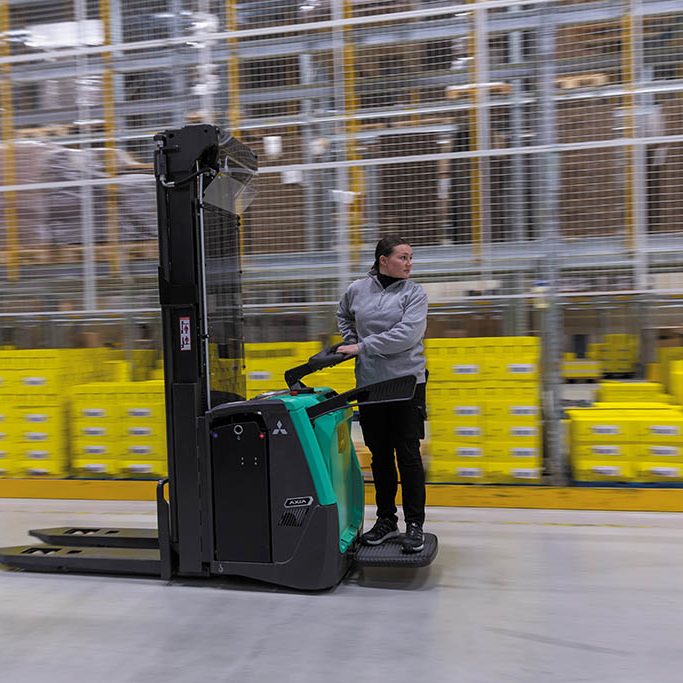
When it comes to forklift truck safety, many people first think of the dangers for the drivers. However, many other people work in a warehouse, often in the immediate vicinity of forklift trucks. They are travelling on foot, pushing roll containers or pulling hand pallet trucks and are exposed to a high risk of accidents: Because if they get in the way of a forklift unnoticed, there is only one winner. The annual report on accidents at work published by the DGUV (German Social Accident Insurance) shows that the risk of accidents when working around forklift trucks should not be underestimated. In 2024, forklift trucks were the leading cause of reportable accidents with almost 6,000 cases, closely followed by non-motorised tiller trucks, i.e. manual hand pallet trucks and high-lift trucks.
In the RIDDOR* accident reports of recent years, it was noted that a second person was involved in over 40 per cent of accidents involving forklift trucks. Of these, over 60 per cent were pedestrians – employees working nearby – and around 20 per cent other people (inspectors, passers-by) and 15 per cent delivery drivers.
These accidents often have devastating outcomes with serious health consequences for those affected and for the company itself: They often result in reputationally damaging investigations, costly compensation claims, legal proceedings and fines. Every company has a duty to ensure the safety of its employees and to minimise all risks as far as possible. Forklift driver training and regular instruction are therefore a must for every company with industrial trucks in use. At the same time, it is equally important to ensure the safety of those who work unprotected in the vicinity of free-moving forklift trucks.
Tips for more protection for pedestrians
Separation is the safest means
The smartest advice for pedestrians in the warehouse is: keep your distance from forklift trucks. Do not enter areas where forklift trucks are manoeuvring and do not enter areas that are closed to pedestrians – not even as a “shortcut” under time pressure!
If pedestrians and forklift trucks are working in the same area, there should be designated walkways separated from other traffic. These should be protected by barriers and emphasised by markings.
Never be tempted to walk or work under a raised load – always keep a safe distance.
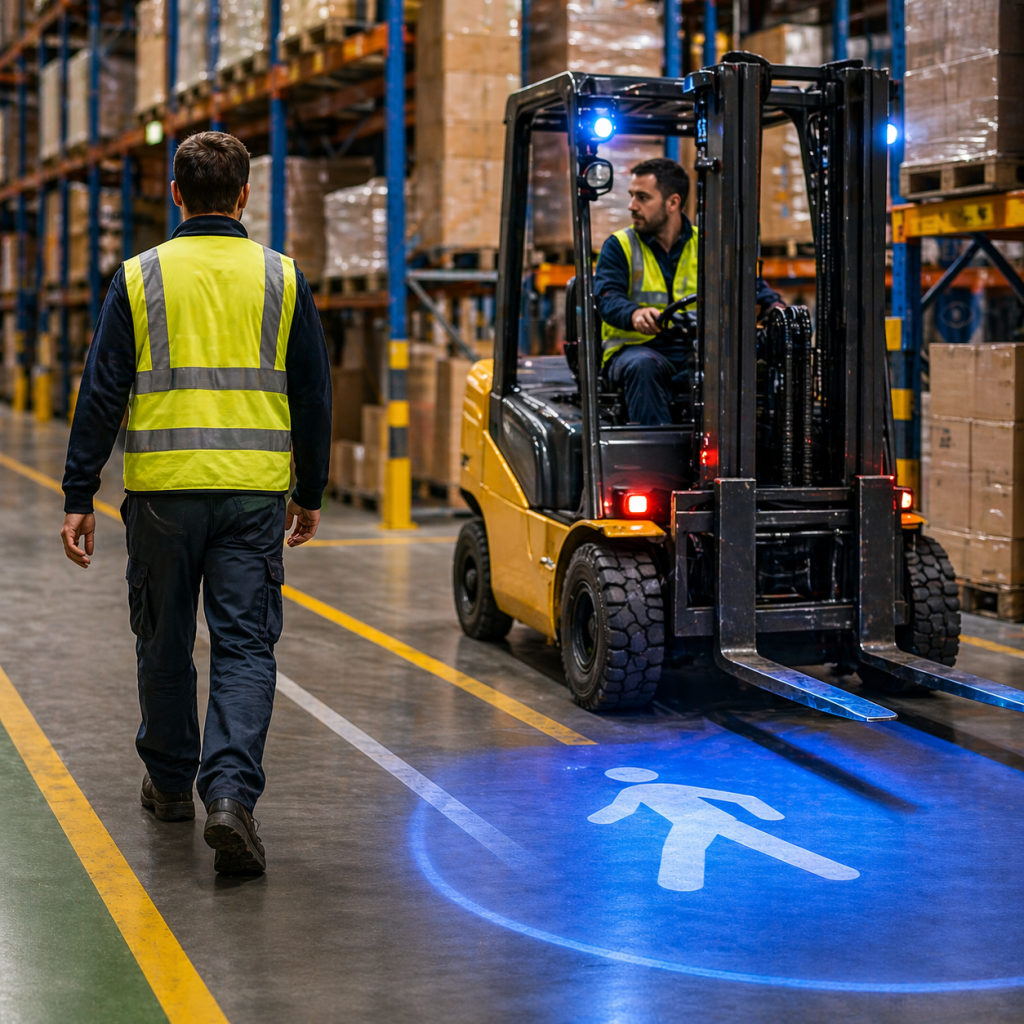
If a forklift truck is equipped with zone warning lights, you should not enter this area under any circumstances. The blue warning lights on the forklift truck mark the danger zone in front of the vehicle. Red marks the danger zones around the forklift truck.
Do not take any risks
Do not ride as a passenger on a forklift truck and never allow yourself to be lifted with the load or the forks.
Never attempt to stabilise a load that is sliding off the forks and do not try to act as an additional living counterweight. People are regularly killed trying to act as a counterweight.
Cautious approach
Always wear high-visibility waistcoats. It is much easier for pedestrians to recognise a forklift truck than it is for the forklift driver to see the pedestrian.
If a forklift truck approaches you, make absolutely sure that the driver has seen you. Only approach the forklift truck when it is stationary – and then only from the side.
Pedestrians need to be extra vigilant in areas where forklift trucks are travelling and working and watch out for blind spots as soon as they enter an aisle, turn a corner or walk through a doorway.
The most common causes of accidents involving forklift trucks
– Inspections and daily maintenance neglected: Whether forklift truck or car – a vehicle that is not technically roadworthy is a danger for everyone involved.
– Safety rules not observed: Forgetting to fasten the seat belt. Forklift left unattended with key so that unauthorised persons can drive it. Load securing forgotten. Bypassed the TOT man switch. Raced, tested the limits…
– The forklift tips over: Due to their weight distribution, forklift trucks tend to tip over quickly. The risk increases enormously, especially when cornering and manoeuvring with a raised load.
– Working in confined spaces: If the forklift truck is heavily loaded, visibility is often restricted and the stress factor is high. Under time pressure, work is hectic and there is an increased risk of overlooking pedestrians.
– The loads are not distributed correctly: The transported goods must always be evenly distributed. Securing against slipping is essential. The higher the mast is extended, the more it can sway.
Modern safety systems in forklift trucks
Renowned forklift truck manufacturers have been investing in the safety features of their industrial trucks for years. Many new forklift trucks already have intelligent systems that warn drivers of dangerous situations or prevent them from arising in the first place. Examples include cornering control systems, person detection and distance sensors, automatic ramp stop, mast stabilisation systems, pin code key systems and much more.
*RIDDOR = Reporting of Injuries, Diseases and Dangerous Occurrences Regulations. The Reporting of Injuries, Diseases and Dangerous Occurrences Regulations is a legal requirement in England.

Country Manager Spain
+49 941-942794-24