Categories
News

New forklift trucks? New warehouse? Or everything new?

New forklift trucks? New warehouse? Or everything new?

Small and medium-sized companies in particular find it difficult to make the right decisions when investing in logistics.

When internal logistics, from warehousing to order picking to shipping, repeatedly come to a standstill due to growing volumes, quick action is called for.

This does not only apply to the trade. Building contractors as well as medium-sized and small companies are often faced with the problem that too much time is lost until all machines, equipment and materials are on the construction site. Too small outdoor storage areas and too narrow aisles in the halls, no system, tools that are too old or unsuitable (forklifts, wheel loaders…) – the reasons are numerous, as are the hours lost every day.

You won’t find any solutions or instant help in this article, but you will find simple examples that will make you think and perhaps help you to improve your own logistics quickly. However, speed should not be equated with quick, hasty action. So don’t just go ahead, plan, rebuild and buy. Good advice is often not expensive. The analysis of a logistics expert probably saves (a lot!) more money than it costs.

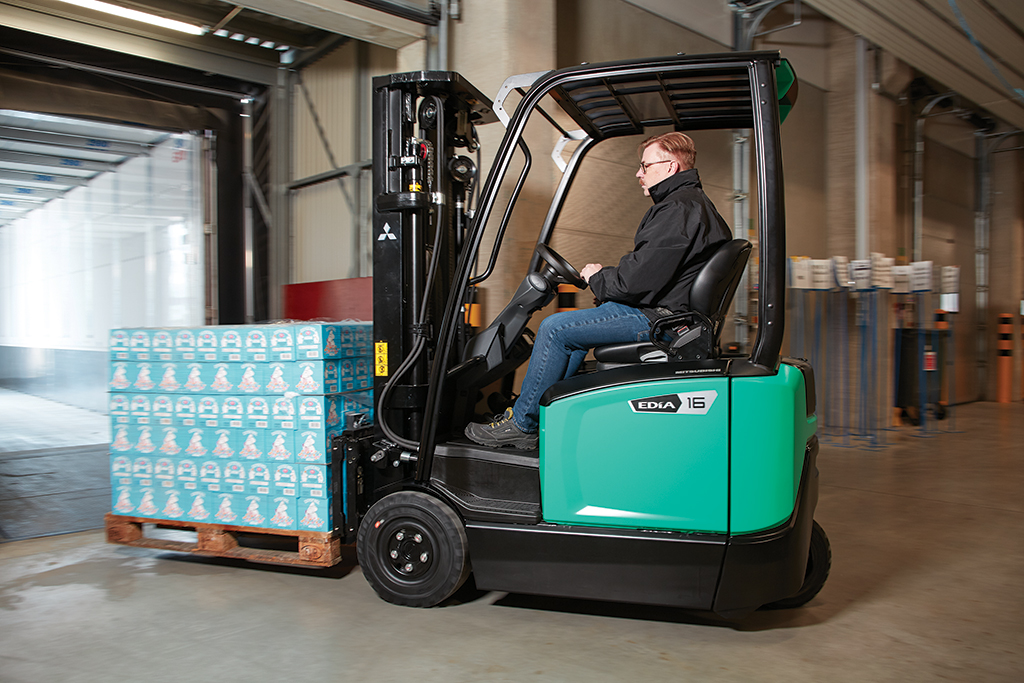
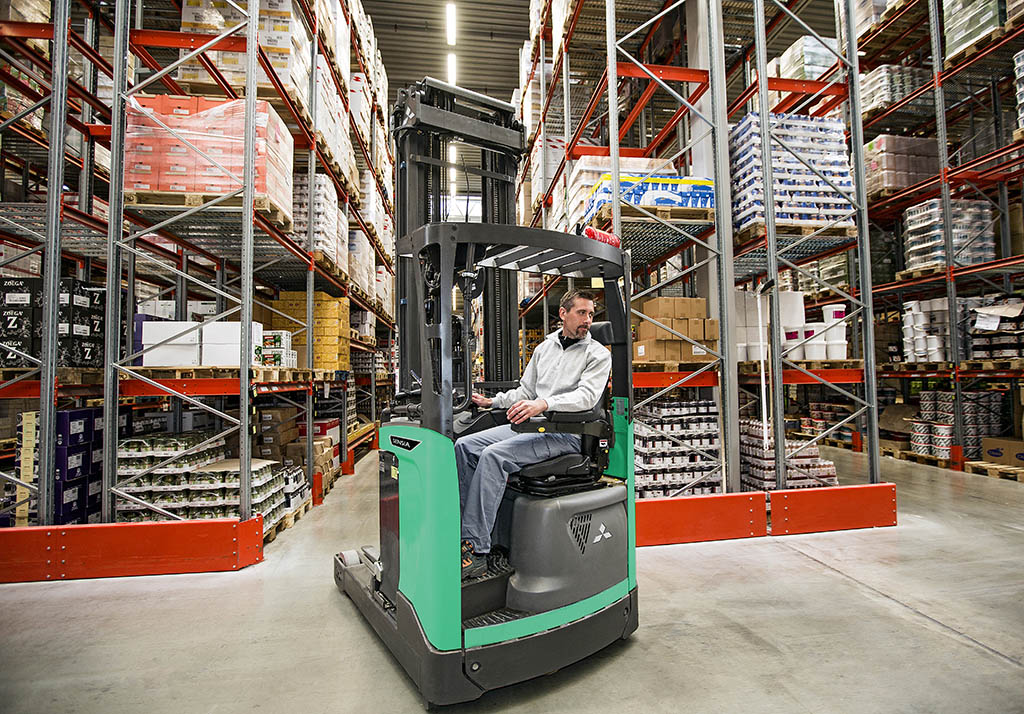
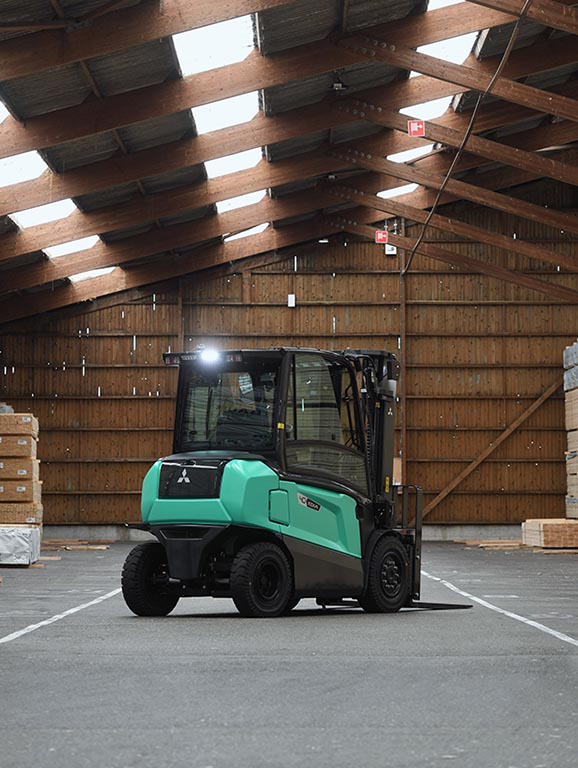
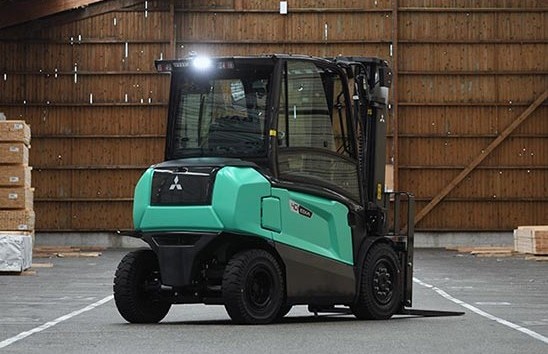
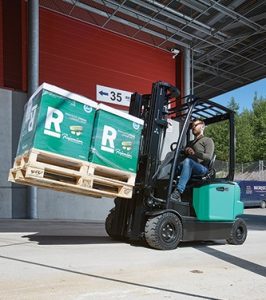
© Mitsubishi EDiA EM 3 wheel
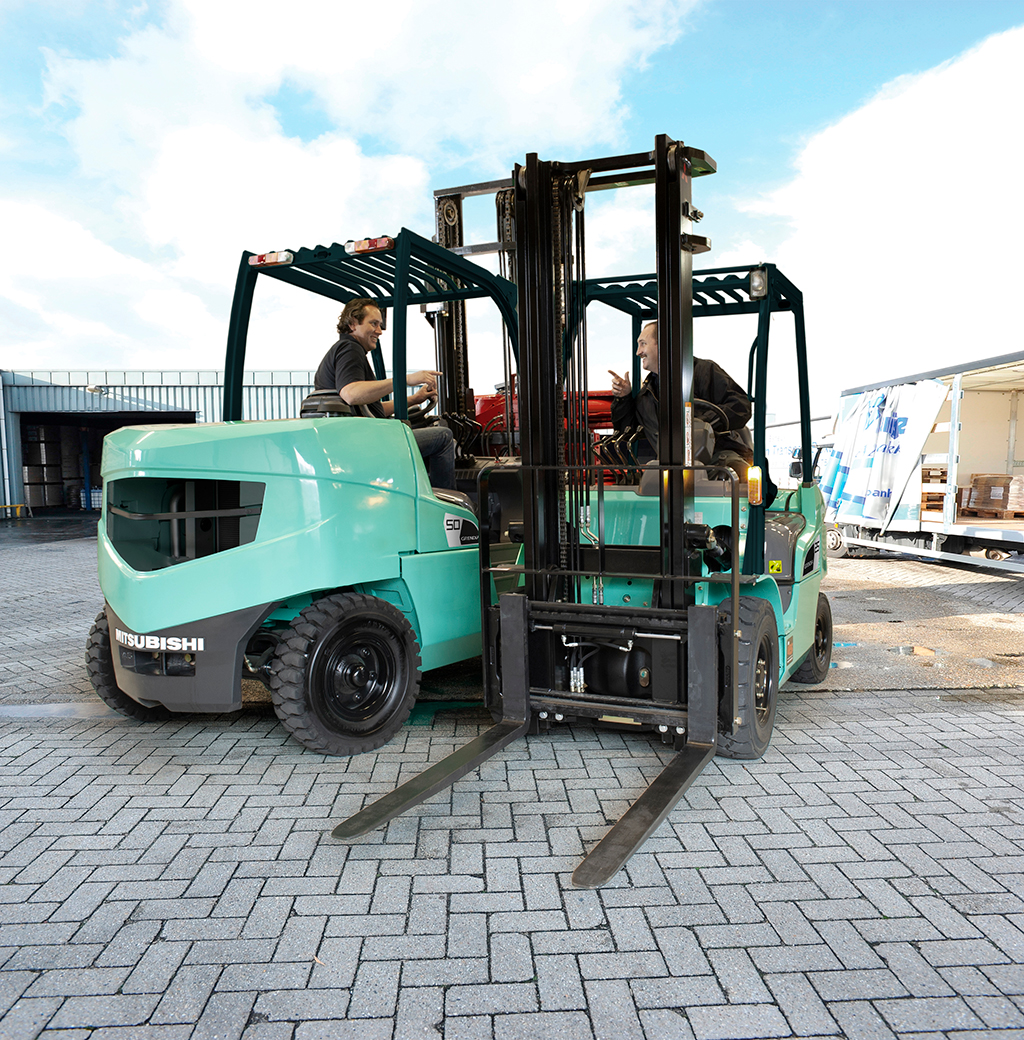
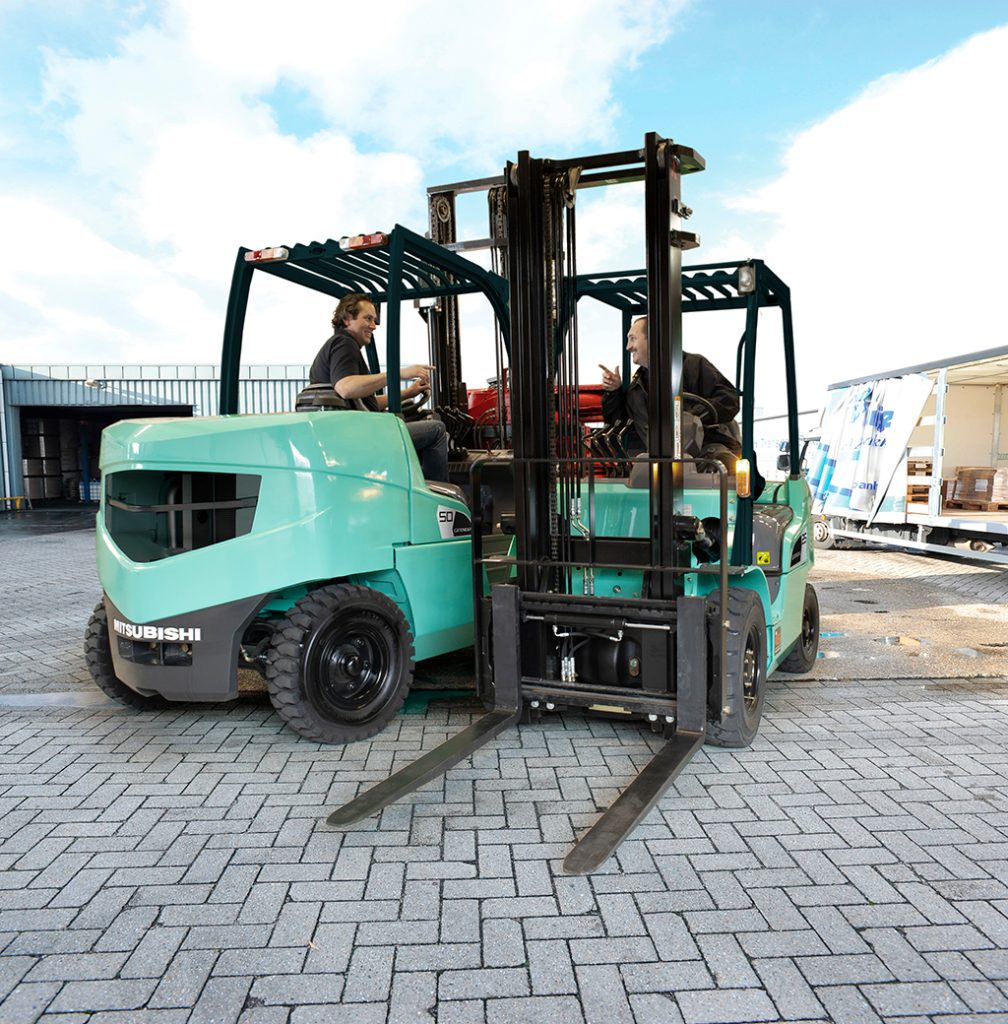
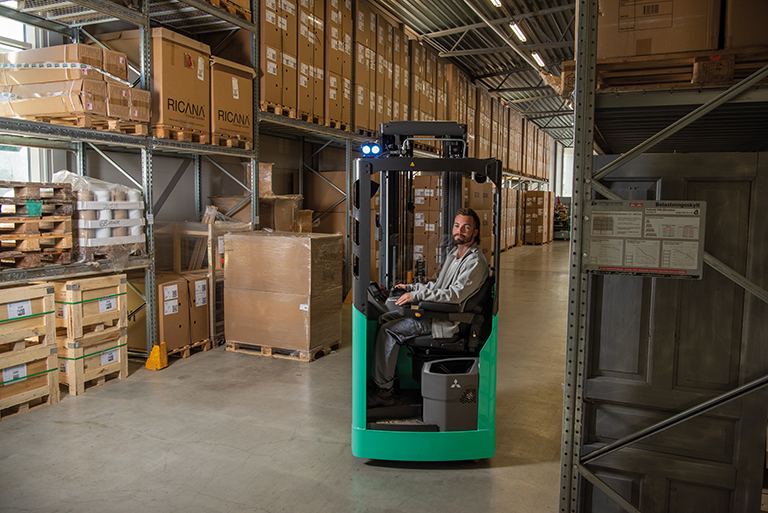
© Mitsubishi AXiA EX Sit-on

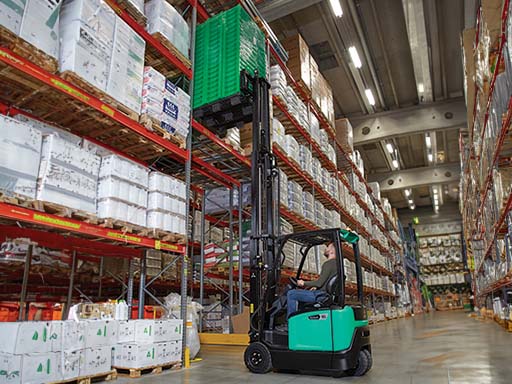
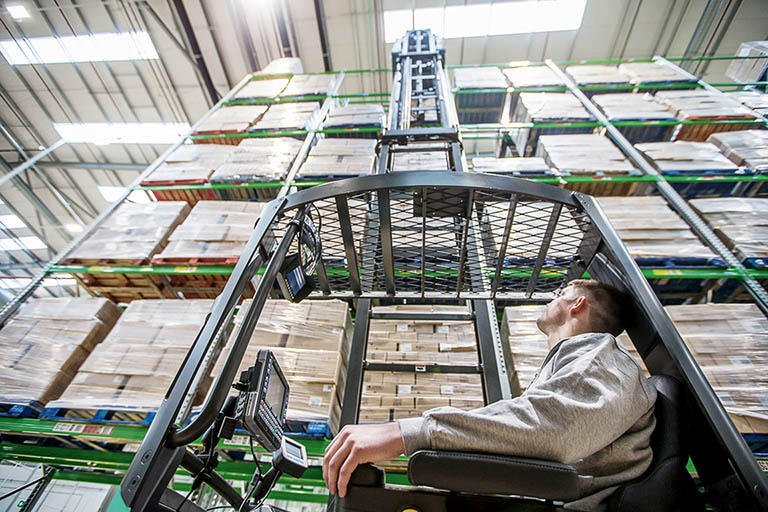
An example: The warehouse is too small! All the shelves are crammed full and the forklifts can barely drive through the aisles. A new hall is needed, larger and with wider aisles. It can be done, but maybe it doesn’t have to be: perhaps it’s better to make the aisles narrower and thus create deeper shelves, which means more storage capacity. Narrow-aisle forklifts, high-lift order pickers or driver’s seat high-lift trucks then take care of storage and retrieval. These then transfer the pallets to forklift trucks, of which far fewer are needed in this system than before. It is easy to calculate whether this is the right approach.

If it turns out that this conversion is not sufficient for the future handling volume, the next step can be to make calculations for conversion to semi-automatic or fully automatic, driverless warehousing. The construction of a new warehouse should also be included in the calculations.

In all planning and calculations, all operating costs must always be taken into account, depending on the operating time. Let’s stick with the example described above: building a new warehouse with more rack space and slightly wider aisles, but otherwise a twin of the existing warehouse, is the cheapest purchase. But more forklifts and more drivers are needed. If you add up the purchase of the machines and the operating costs for people and machines, the apparently cheapest solution becomes a cost trap, and another variant, such as a fully automated 4.0 warehouse, is suddenly the price-performance winner.

Time is also a decisive factor. Not only the time lost in searching, clearing back and forth, but also time that has been wasted because everything has always gone well so far. These are often small and medium-sized companies where working methods and warehouse structures have not been adapted to actual requirements over the years. We are talking about the beverage store with 2 forklifts and 5-10 high-lift trucks, the building materials trade with forklifts and wheel loaders or the tiler with tile storage and sales.

Those who wait until almost nothing is moving before investing in their fleet and warehouse often make hasty decisions in the hope that everything will be fine afterwards. It is better to buy time with small investments, used industrial trucks and rented storage space to get professional advice and weigh up all the options.

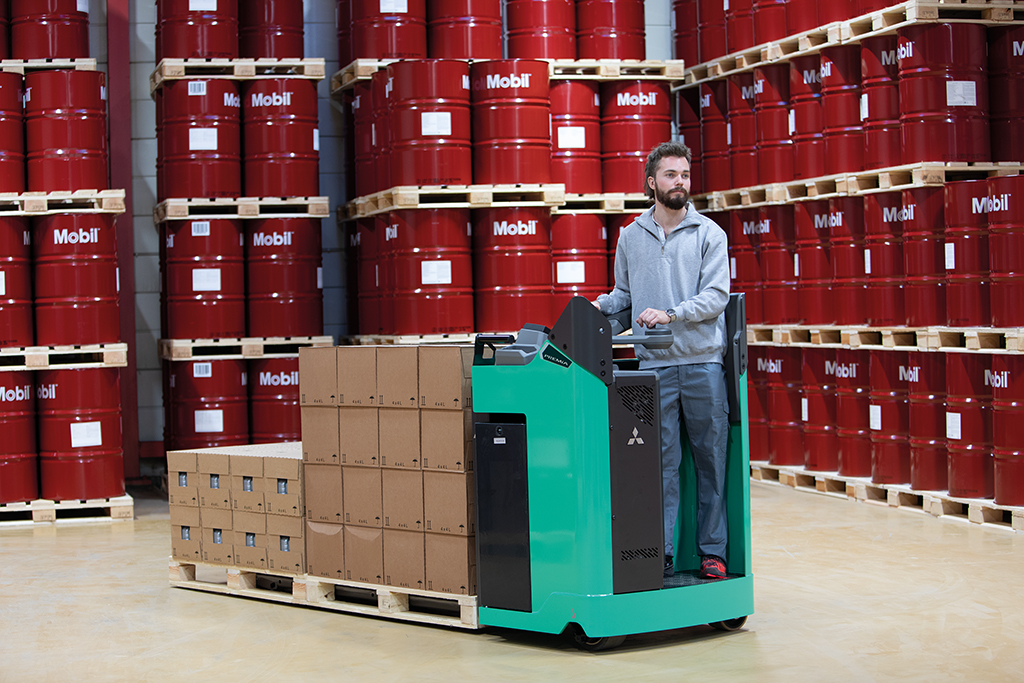
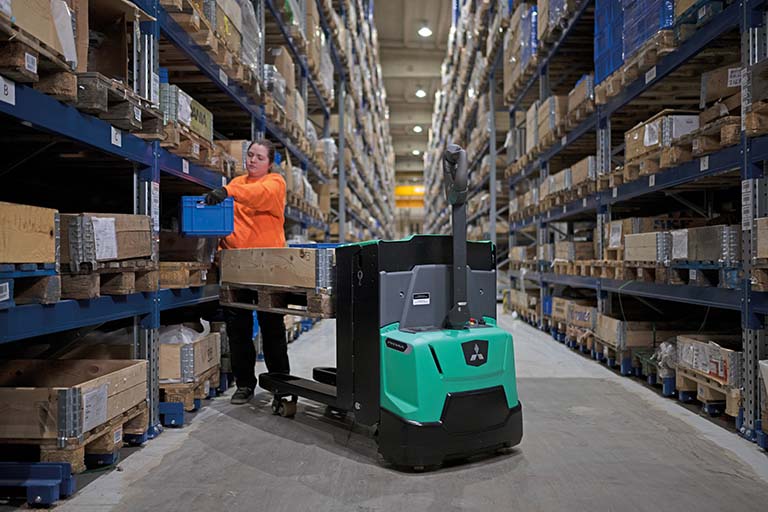
© Mitsubishi PREMiA ES Pedestrian

Warehousing and transportation are a complex business.

There is no one-size-fits-all solution for all jobs. Every transport operation and every workplace has its own individual requirements, its own challenges and its own standards. The right choice of technology and storage locations makes every operation more efficient, more productive and safer. And regular review – has the situation changed, are there different standards, are the machines still optimal for the job, what is the competition doing better or worse – makes the difference between success and decline.
When it is time to replace or expand the equipment fleet, it is always advisable to re-evaluate the requirements and the complete warehouse setup. Are new specialized forklifts perhaps the better choice for this or that task?
It’s old wisdom: if everything fits together, if the machines are matched to the application, this promotes efficiency. Even small changes can have a big impact. There is no warehousing without risk. A holistic approach that takes energy efficiency, sustainability, location advantages and future prospects into account reduces the risk of making the wrong decisions.

Looking for devices?

Don’t want to miss anything?

Categories
News

Assistance systems in industrial trucks

Assistance systems in industrial trucks

An assistance system is a technical, often fully automated solution that supports machine operators in carrying out their logistical tasks. It can provide important information and assistance, as well as fully automated intervention when needed. These systems are increasingly based on artificial intelligence, enhancing safety and boosting productivity in everyday material-handling operations.

Digital helpers are everywhere. Drivers know them well: it beeps when reversing, it beeps when moving forward, and if we ignore it—because the warning threshold is set quite low—the onboard computer may even trigger emergency braking. That can be annoying. On the other hand, adaptive cornering lights, adaptive cruise control, and many other assistance systems are genuinely useful enhancements.

Industrial trucks have long been equipped with a wide range of digital assistance systems. In practice, legal requirements vary by country, industry, and application. As with any new business investment, it’s important to determine what is necessary, helpful, and productive—and what is not.
For example: The owner of a small company employs three forklift drivers and has three forklifts. When buying a new truck, he chooses a model with PIN-code access because all individual seat and steering-wheel settings are saved and automatically adjusted for each driver. This means he no longer needs to set everything manually. However, he hardly ever drives a forklift himself, and his three drivers do not normally switch machines during day-to-day operations. Economically speaking, it’s not essential, but it’s a nice feature to have. Profitability isn’t always the only factor.

Key assistance systems that prevent accidents and increase productivity

  • Adaptive cruise control reduces speed in curves, on uneven surfaces, or when carrying heavy loads.
  • Stability and tilt-warning systems detect potentially dangerous tipping angles before the truck becomes unstable and warn the driver in time.
  • Front and rear cameras or mirror-assist systems improve visibility, especially to the rear and in narrow aisles.
  • Lift and load monitoring uses sensors to check load weight, center of gravity, and fork position, issuing warnings when capacity limits are exceeded.
  • Load stabilization and mast-tilt adjustment enable safe depositing, tilting, and lowering of loads—even on uneven ground—and reduce mast sway at height.
Mitsubishi EDiA XL with Blue-spot
© Mitsubishi EDiA XL with Blue-spot
Mitsubishi SENSiA with sway control
  • Automatic fork positioning with laser sensors allows precise pallet handling while preventing cargo damage.
  • Pre-set driving modes, similar to those in cars, provide added safety for beginners or full performance for experienced operators, depending on the task.
  • Sensorimotor controls adapt to the driver’s handling style; the system responds sensitively to steering movements and lever pressure, making operation more intuitive (steering, acceleration).
  • Automatic ramp-hold prevents the truck from rolling backward on inclines as soon as the accelerator pedal is released—the driver can simply step off; when they return and accelerate, the brake releases automatically.
  • PIN-code and other key systems prevent unauthorized use and automatically apply each driver’s stored preferences.
  • Adaptive load-distribution and gripping-angle systems adjust gripping and lifting angles to the size of the load.
  • GPS and navigation systems optimize routes in outdoor areas and large indoor environments, reducing travel times.

Systems with limited benefit (gimmicks)

  • Too many cameras or sensors without meaningful application distract more than they contribute to safety.
  • LED “light shows”—too many rear or side warning lights—reduce safety benefits because they distract more than they warn.
  • Complex network integrations without clearly defined operational processes create more cost than benefit and increase maintenance requirements.

Practical tips for new purchases

  • Create a checklist with your drivers outlining 5–10 aspects of the current forklift that could be improved. Then review how often these issues occur. Ask your forklift or warehouse-technology supplier for a quote including the relevant assistance systems. Compare costs and benefits—remember that ergonomic workstations often reduce sick days and increase motivation, which boosts performance.
  • Safety first: choose systems that demonstrably reduce risks (anti-tip, collision-avoidance, and load-warning systems).
  • Check compatibility: systems should suit your load types, pallets, warehouse layout, and existing fleet.
  • Training: assistance systems are only effective when drivers recognize and accept them as useful. This also requires regular updates and proper training.
Mitsubishi EDiA EM 4Wheel (with laser on pallet)
Mitsubishi EDiA EM 4Wheel with automatic ramp stop

Conclusion

Assistance systems improve safety, reduce damage, and increase productivity. In principle, all forklifts should be equipped with load monitoring, visual detection, and obstacle-detection systems. Extravagant hardware or software without clear benefits should be avoided.
Despite these technological aids, the operator remains responsible: assistance systems do not replace daily visual inspections and do not relieve anyone—neither warehouse managers nor drivers—of their responsibility for the safety of people and goods in day-to-day operations.

Looking for devices?

Don’t want to miss anything?

FORKLIFT - La red de distribuidores más grande de la industria

Comprar barato - ¡Vender más rápido!

¿Alguna pregunta?

Contáctanos directamente:

Ana Fischer


Country Manager Spain

+49 941-942794-24